The older text on this page said almond butter beats peanut butter and promised foods that help you lose weight, without testing either idea. Nuts are a fair place to start. The pistachio paper below opens by noting a widely held view that snacking on nuts, because of their high fat content, will lead to weight gain. Gram for gram they do carry a lot of energy. Five of them are below: four from the weight trials described here, and dates, which were not part of any of them. The trial results are more mixed than the “potent” label suggests.
How much energy each one carries
USDA FoodData Central gives these figures per 100g: almonds 579 kcal, raw peanuts 567 kcal, raw pistachios 560 kcal, Medjool dates 277 kcal and raw avocado 160 kcal. The nuts get most of that from fat, with 45g to 50g of it per 100g. Medjool dates get theirs from sugar, 66.5g per 100g, and have almost no fat at 0.15g. On those numbers dates hold about half the energy of the nuts and about 1.7 times that of avocado.
1. Almonds, in two trials that disagree
At City of Hope in California, 65 adults with overweight or obesity, aged 27 to 79, spent 24 weeks on a formula-based low-calorie diet (PubMed 14574348). One group had 84g of almonds a day added to it. The other had self-selected complex carbohydrates instead, with the same calories and protein. Weight and body mass index fell by 18% in the almond group and by 11% in the carbohydrate group. A correction to the paper was published the following year.
A longer trial at Temple University in Philadelphia put 123 adults through an 18-month behavioural weight programme on a reduced-calorie diet, either with almonds or with no nuts at all (PubMed 22743313). At six months the almond group had lost slightly but significantly less, 5.5kg against 7.4kg. By 18 months there was no difference between the groups, and both had lost what the authors call clinically significant amounts. One trial favoured almonds and the other did not, so neither settles the question alone.
2. Pistachios as the afternoon snack
In Los Angeles, adults with obesity followed one of two weight loss diets for 12 weeks, each set at 500 calories a day below their resting metabolic rate (PubMed 20833992). The two diets had the same calories and differed in the afternoon snack. One group of 31 had 53g of salted pistachios, about 240 calories. The other group of 28 had 56g of salted pretzels, about 220 calories.
Both groups lost weight. Body mass index went from 30.1 to 28.8 in the pistachio group and from 30.9 to 30.3 in the pretzel group, and the change differed significantly between them. The authors conclude that pistachios can be eaten as a portion-controlled snack by people cutting calories, without concern that they will cause weight gain.
3. Peanuts, with and without instructions
A Purdue University study gave 15 healthy adults of normal weight about 505 kcal of peanuts a day across a 30-week crossover design (PubMed 12119580). For 8 weeks they had no dietary advice at all. For 3 weeks they were told to add the peanuts to their usual diet. For another 8 weeks the peanuts replaced an equal amount of other fats.
With no advice, the rest of people’s diet compensated for 66% of the energy in the peanuts. They gained 1.0kg, against the 3.6kg predicted if nothing else had changed. When the peanuts replaced other fats, energy intake and body weight held steady. The participants did not know that body weight was a focus of the study. No one in this study was put on a weight loss diet, so it speaks to weight gain, not loss.
4. Avocado, one a day for six months
The Habitual Diet and Avocado Trial, run across several US centres, enrolled 1,008 people with a large waist (PubMed 35861827). One group was given one large avocado a day for six months and the other kept to its usual diet. The main question was whether visceral fat, measured by MRI, would fall. It did not differ between the groups. Changes in body weight and body mass index were also similar.
So over six months a daily avocado made no difference to weight compared with the usual diet. The trial’s design paper lists one of its authors at the Hass Avocado Board (PubMed 34496276).
5. Dates, which none of these trials used
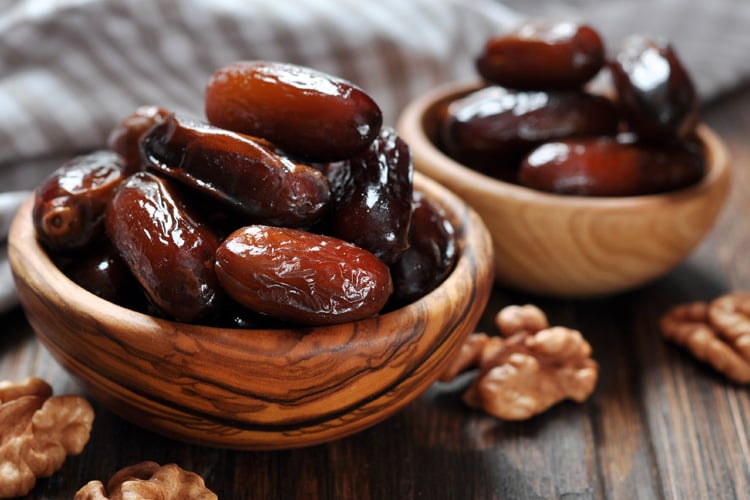
None of the trials above used dates, so they cannot say what dates do to weight. The closest guide is a portion rule. The NHS counts a 30g portion of dried fruit, dates included, as 1 of your 5 A Day, and says it should be eaten at mealtimes, not as a snack between meals, to reduce the impact on teeth. Using the Medjool figures from FoodData Central, 30g comes to about 83 kcal and 2.0g of fibre.
That differs from the pistachio trial, where the nuts were an afternoon snack. For dates, the NHS advice points to the meal itself, kept to that 30g.
What these trials add up to
Energy-dense foods did not behave the same way in every trial. Almonds helped in one 24-week trial and made no lasting difference in an 18-month one. Pistachios beat pretzels on the change in body mass index over 12 weeks. Peanuts, eaten freely, added less weight than their calories predicted, and a daily avocado changed neither weight nor visceral fat. In the three weight loss trials here, the food sat inside a calorie-cut diet.
Buying dates from Rotab Mozafati Bam
Rotab Mozafati Bam offers prices for both retail and wholesale buyers, delivers across Malaysia and runs customer service on WhatsApp, as its about us page says. For a price quote, stock availability or delivery questions, use the form or the WhatsApp button on the contact page. Other articles are on the blog.
An earlier version of this post linked to https://KurmaHarga.com, and that link stays here.
This article is general information, not personal advice. If you plan a big change to the way you eat, speak to your GP or a dietitian first.